
The CGLG is honored to host various speakers throughout the semester. From lectures to book launches, we are constantly striving to provide the St Andrews community with opportunities to learn from fellow academics.
Academic Talks 2025/26
International law and emotions: challenges and prospects

with Professor Andrea Bianchi
Tuesday, 14th April 2026
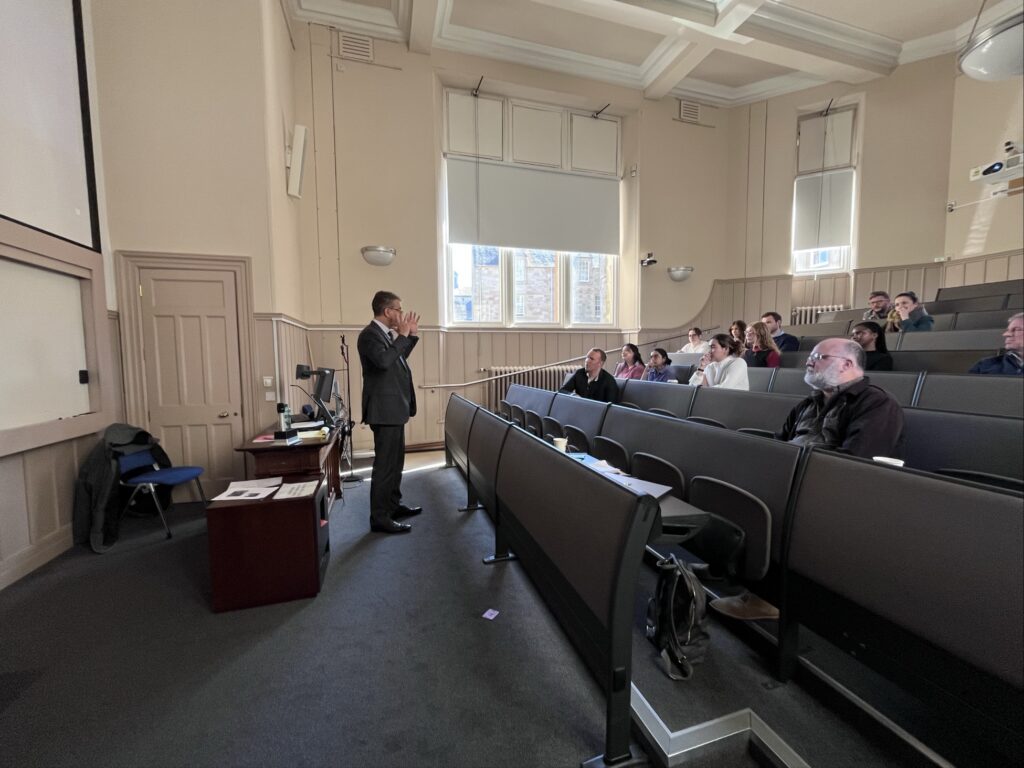
At this CGLG event, Professor Andrea Bianchi of the Geneva Graduate Institute presented his work on international law and emotions.
Andrea’s research interests lie in treaty interpretation and the production of knowledge, as well as the ‘unsaid’ and the ‘unseen’ in international law. His recent books include: Demystifying Treaty Interpretation (co-authored with Fuad Zarbiev), CUP (2024) and International Law’s Invisible Frames: Social Cognition and Knowledge Production in International Legal Processes (co-edited with Moshe Hirsch, OUP, 2021). The second edition of his monograph International law Theories: An Inquiry into Different Ways of Thinking (OUP 2016) is under way.
Andrea discussed how the study of emotions in international legal processes has gained traction lately, but fundamental challenges remain as to what a research agenda in this area might look like as well as what methodologies should be used in the pursuit of such an investigation. The aim of his research is to foreground some of the main challenges in developing this relatively new field of international legal scholarship, as well as the main prospects for moving it productively forward.
Ultimately, navigating through the universe of emotions represents not only a challenge but an incredible opportunity for international lawyers to overcome the narrow boundaries of classical jurisprudence and to provide a better explanation of how international legal processes actually take place.

To the Rescue – Rupture and Resilience of the UN Charter Order
with Dr Antje Wiener
Wednesday, 25th Feburary 2026
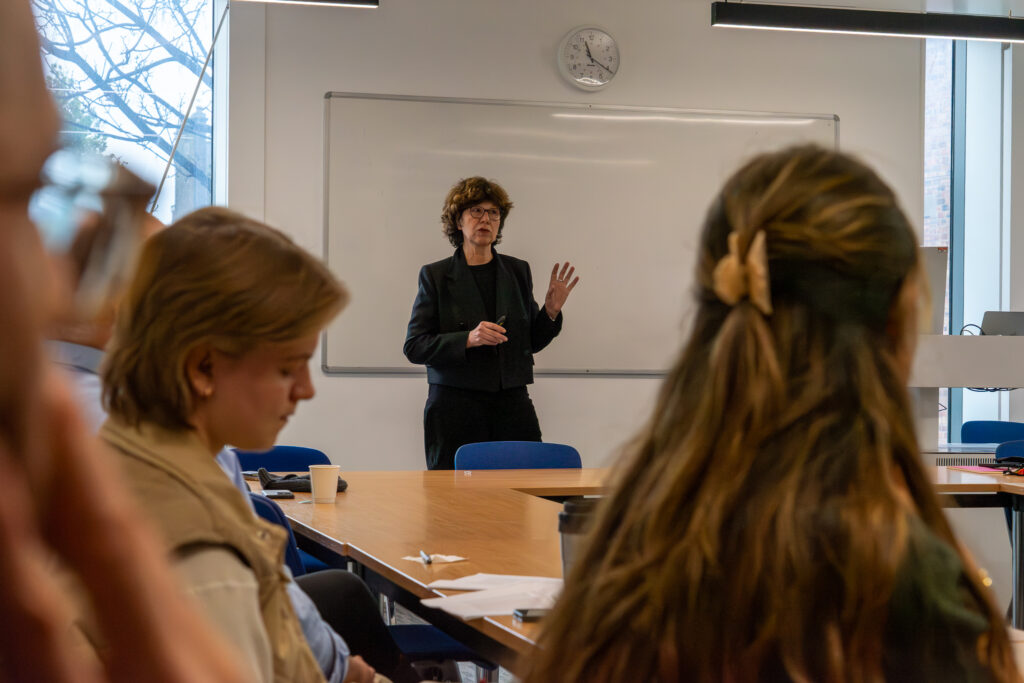
Abstract: The rule-based international legal order is under duress. Recent breaches of international law on behalf of members of the United Nations (UN) Security Council’s permanent members represent deep contestations with potentially destructive consequences for the UN Charter Order. These ruptures raise issues about adequate political strategies of reaction (or retaliation) which are related with conceptual questions of the UNCO’s resilience in the mid- and long-term. While a rule-based order faces predictable non-compliance with and violations of norms which are handled as a matter of routine, thereby documenting the liberal international order’s resilience, the qualitative shift from ‘normal’ to ‘deep’ contestation cuts to the core in a potentially order- changing way. This raises novel questions about the resilience of the UNCO, and global order, more generally. Defined as the capability to maintain pathways to participation that warrant affected stakeholders’ access to normal contestation, resilience is enhanced by pathways that enable normal contestation (i.e. proactive engagement with norms) towards deep decarbonisation, or to counter human rights violation, genocide, torture or the illegal use of force. While such pathways are shaped by organising principles and fundamental norms that have long guided global politics, they are now challenged by the very member states that established them with the UN Charter in 1945. Given the novelty, no prediction of constructive or destructive effects of deep contestation can be made. Yet, it is possible to examine the effects beyond observation and description. This talk invites a discussion of a multi-method integrated theoretical framework to evaluate the effects against the background of five contestation scenarios developed from norms research in International Relations and International Law. It takes an innovative mid-range focus on institutional change and identifies sources (norm agents) and dynamics (social and legal) as drivers towards plausible future scenarios. This objective is addressed by recursive theorising in conjunction with empirical research (mapping, modelling, evaluating) that zooms in on contestations over justice and security.
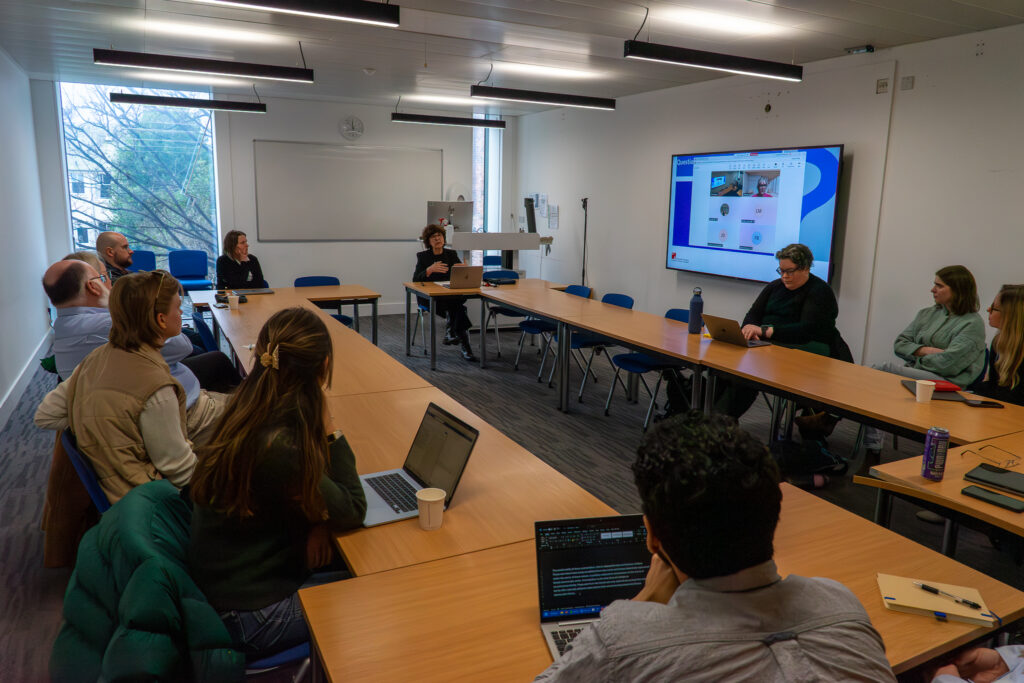
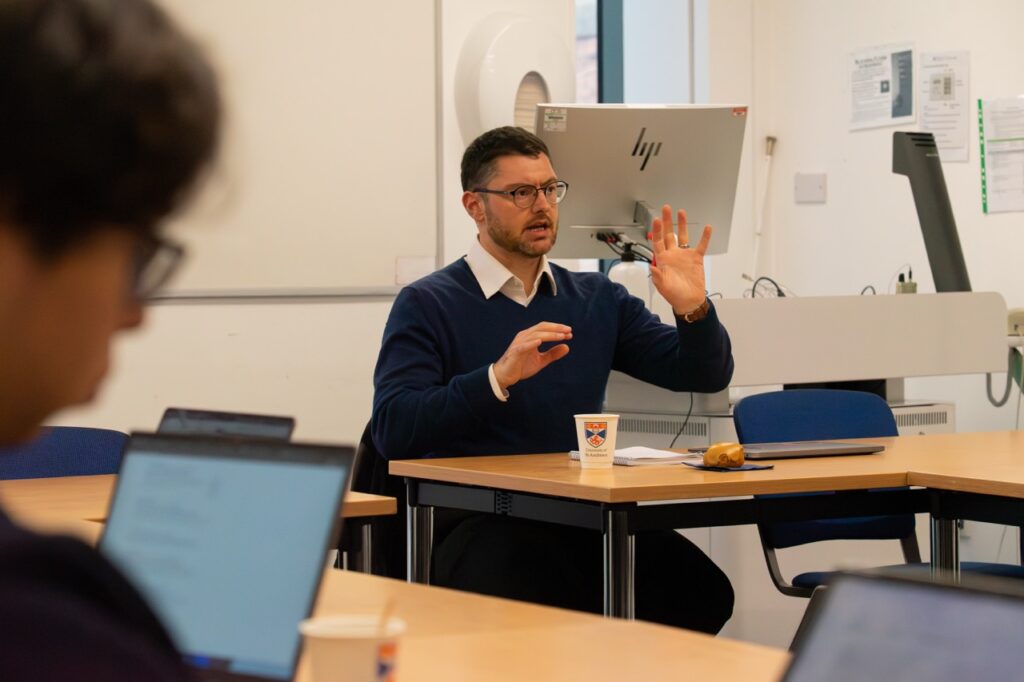
Mercenary: genealogy of a concept in international relations
with Dr Malte Riemann
Wednesday, 18th February 2026
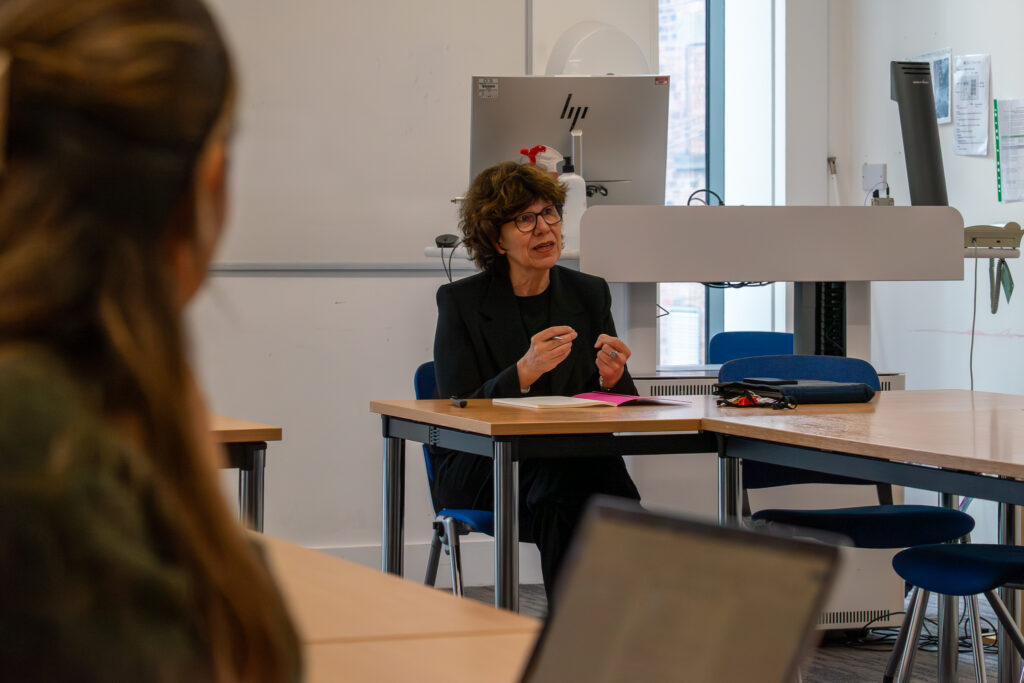
At this CGLG event, Malte Riemann, Assistant Professor at Leiden University, joined us to discuss his book proposal, Mercenary: Genealogy of a Concept in International Relations.
Mercenaries, once relegated to the annals of history, have re-emerged as a pressing concern for international security. In conflicts spanning the globe, from Libya over Nagorno-Karabakh to Mali, the use of mercenaries has garnered increasing attention. The recent involvement of the Wagner mercenary group in the war in Ukraine captured global interest, propelling the topic to the forefront of scholarly and public discourse (Kinsey, 2023; Cusumano and Kinsey, 2022; Gentil-Fernandes, Morrison and Otto, 2023).
Curiously, the mercenary is frequently portrayed as a timeless figure, seemingly involved in conflicts since the beginnings of recorded history. As Sean McFate recently remarked: “Mercenaries are everywhere in military history, starting with the Bible.” (2019, 11). Scholars and practitioners in international relations (IR) and other disciplines repeat the view that mercenaries are a historical constant that can be found always and everywhere, allowing scholars to make grand historical claims about the organisation of force within world history (Thomson, 1994; Avant, 2001; Percy, 2006; Singer, 2006; Salzmann, 2008; Abrahamsen and Williams, 2009; Panke and Petersohn, 2012; Parrott, 2012; Crawford, 2015; Casiraghi, 2022; Olsen, 2022).
However, this prevailing perception deserves closer scrutiny. Mercenary: Genealogy of a Concept in International Relationschallenges the established belief in the enduring nature of mercenaries and demonstrates how the concept of the mercenary has been historically produced. By tracing its development from the 15th century to the present, this book shows that the mercenary is not as “old as war itself” (Percy, 2006) but that the concept emerges in 19th-century Europe before spreading globally in the mid-20th century through the process of decolonisation.
As such, this book dismantles the assumption that the mercenary predates the modern state and the system of states, revealing that its existence is grounded within and shaped by these modern achievements.

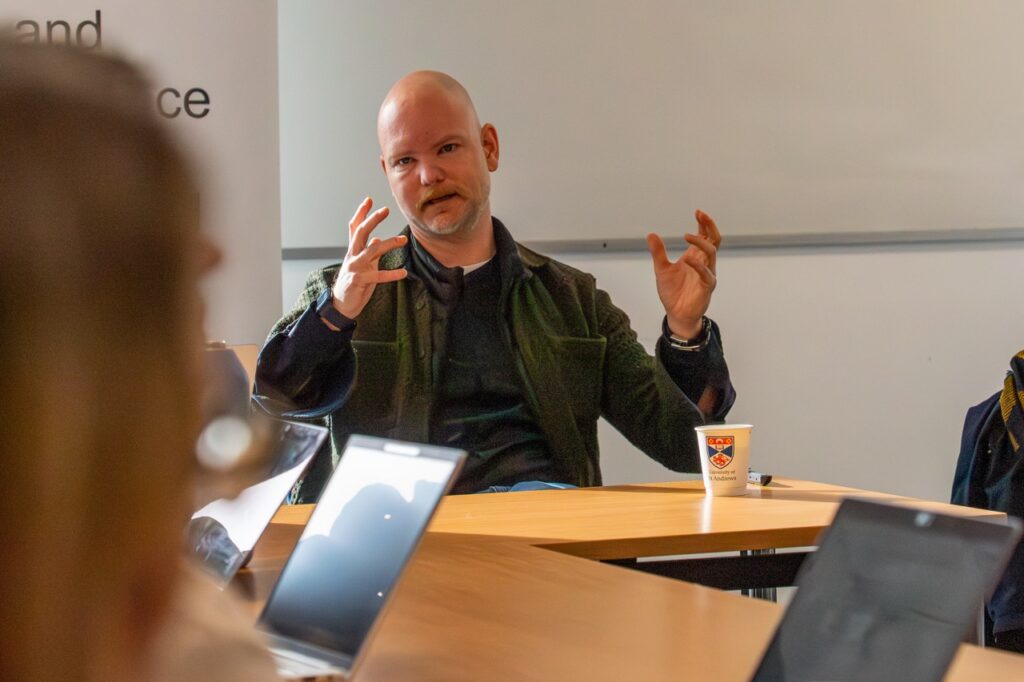
“The Climate Challenge: can China lead the way?”

with Dr Kim Vender
Wednesday, 12th November 2025
A look at China’s evolving role of global climate leadership, from international negotiations to domestic debates on responsibility and development.
Dr Kim Vender is a social science researcher with a special interest in foreign policy and international relations, climate change and biodiversity, and Nature-based Solutions (NbS) to the multiple crises we are facing. She is currently an Affiliated Researcher at the Centre for EU-Asia Connectivity (CEAC) at Ruhr University Bochum in Germany.
She conducted her PhD research on China’s role in global climate change governance with a special focus on climate leadership. Kim’s thesis, Bound to lead? China’s role in climate change governance between perception, conception, and behaviour, was supervised by Professor Juliet Kaarbo and Associate Professor Oliver Turner.
She is currently working on a NbS project for the Social Responsibility and Sustainability department and as a tutor in the School of Social and Political Science, connecting the local with the global.
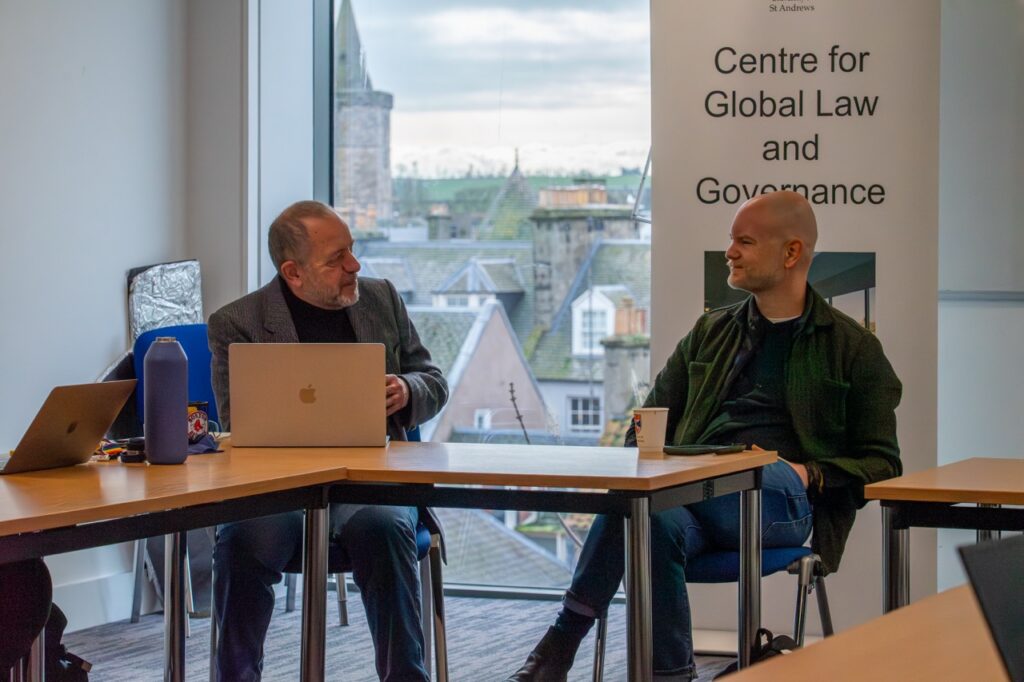
“Brexit and the Trust Paradox of Sovereigntist Internationalism”
with Ben Martill
Wednesday, 5th November 2025
This paper posits that sovereigntist governments (Trump, Johnson, Bolsonaro, the like) encounter a paradox when they seek to transpose existing forms of institutionally-dense cooperation into looser forms while retaining underlying levels of inter-state engagement. This is because lost control needs to be substituted by enhanced trust and trust-worthiness, both of which these actors struggle to generate. The argument is illustrated by the May government’s efforts to shift the UK-EU relationship into less binding formats without incurring economic damage.
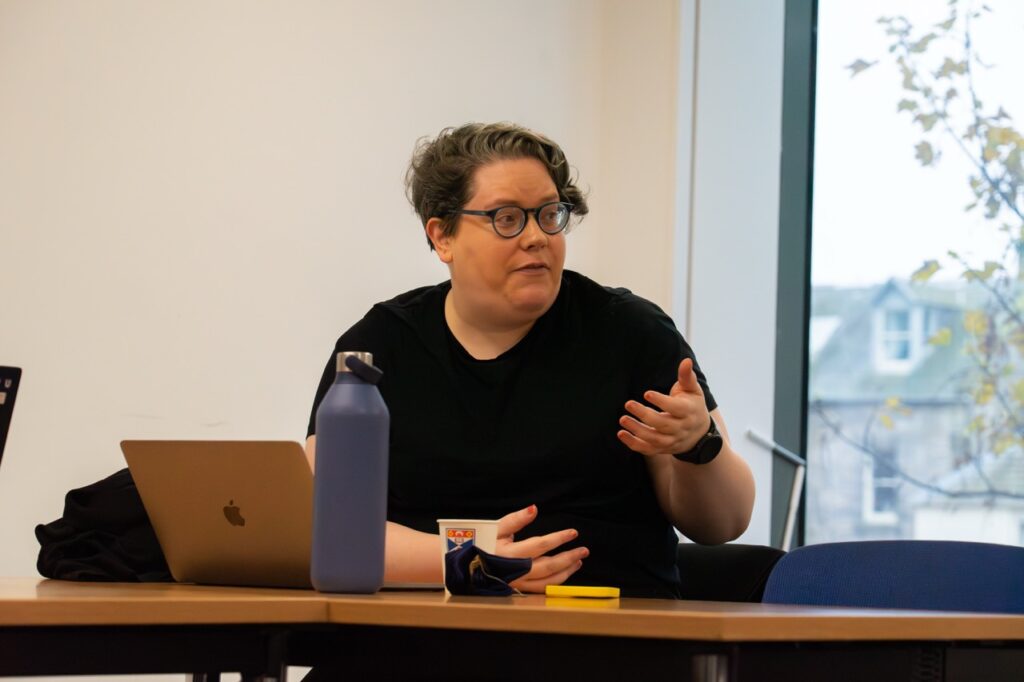

“Constructing Asia: Geography, Identity and the Struggle for Global Order”
Dr Ahmad Rizky Mardhatillah Umar on Monday, 13th October 2025

Constructing Asia presents a new history of the idea of Asia in world politics by showing the dynamic global contestations that enables the emergence of multiple ideas of Asia. Over time, various countries, individuals, and social groups articulate their interpretations of Asia to strengthen or challenge global orders. These ideas are often clashed in the struggle to establish or challenge global orders. Combining theoretical innovation and detailed historical analysis, this book unpacks the epistemic, normative, and political elements that underpin five ideas of Asia in world politics, as well as the mobilization of these ideas in the contestation for global orders, particularly in the last two centuries. This book, specifically, examines five ideas of Asia that have emerged in world politics since the 19th century: (1) Western conceptions of Asia, (2) Pan-Asianism, (3) postcolonial ideas, (4) Asian regionalism, and (5) emerging trans-regional conceptions of Asia. Across six chapters, this book shows that ideas of Asia have been mobilised by different political agents to justify their visions of global order. In a time of increasing US-China geopolitical competition and hypes about the rise of Asia, this book offers a critical understanding of ‘Asia’ and the role it plays in changing global order.
Dr Ahmad Rizky M. Umar is a Marie Sklodowska-Curie Postdoctoral Fellow at the Department of International Politics, Aberystwyth University. He completed his PhD in Political Science and International Studies at the University of Queensland in 2022 and taught at the University of Queensland and Griffith University in Brisbane, Australia, before moving to Wales in 2024. Umar is an expert in Asian regionalism, Indonesia’s foreign policy, and Indo-Pacific security. He has published articles in International Affairs, Alternatives, International Journal, Development in Practice, Asian Politics and Policy, Global South Review, and Studia Islamika. His MSCA postdoctoral fellowship unpacks the politics of transregionalism in world politics after the Cold War.
“The politics of hybridity in global crisis governance”

with Prof. Christian Kreuder-Sonnen
Wednesday, 1st October 2025
At this Centre of Global Governance (CGLG) event, we welcomed Prof. Christian Kreuder-Sonnen (Friedrich Schiller University Jena) and discussed his article on “the politics of hybridity in global crisis governance” (with Dr. Juanita Uribe, Geneva Graduate Institute). The article argues that the growing entanglement of public and private actors in responses to transnational crises is less a functional adaptation to complexity than a deliberate reconfiguration of global power and authority. Hybrid arrangements elevate private actors as co-governors and subordinate public goals to commercial logics under the banner of urgent collective action. Bringing together debates on crisis governance and hybrid global governance (e.g. public-private and multistakeholder partnerships) the article foregrounds the distinctive political work crises perform in enabling and normalizing these institutional forms. Shifting attention from effectiveness to questions of authority, accountability, and definition of the public good, it highlights the distributive politics embedded in crisis-induced hybridity. These dynamics are illustrated through two cases: the Scaling Up Nutrition (SUN) initiative that emerged after the 2008 food crisis, and the Access to COVID-19 Tools Accelerator (ACT-A), particularly COVAX, during the COVID-19 pandemic.


Past Academic Talks 2024/25

The Politics of International Norms
Book launch
Anette Stimmer
Hosted by ILCR
Thursday, 17 April, 11:15
Anette Stimmer’s recently published book ‘The Politics of International Norms: A Rhetorical Approach’ (Cambridge University Press, 2025) sheds light on the effect episodes of contestation can have on norm strength. By using insights from rhetorical theories, she shows that it matters what norm elements are contested. Disagreements on the norm frame (e.g. over whether ‘due process’ or the UN Security Council’s prerogative prevails) tend to involve more uncertainty about the international community’s expectations than narrower disagreements on the behavioural claim (e.g. whether an Ombudsperson or an international court shall safeguard due process). The greater the uncertainty about what the international community considers appropriate, the weaker the norm. Furthermore, the book explains how three classical elements of rhetoric – speakers (including delegation to agents), argumentation and audience reactions – influence the duration of contestation and its outcome. The reactions of in-group members, for instance, are particularly influential for whether contested norm interpretations can be upheld. This rhetorical approach is applied to eight recent norm disputes, including the lead-up to the 2003 Iraq War, the 2011 No-Fly Zone over Libya, the South China Sea dispute, and contestation over the human rights of terror suspects. You can find more information about the book here: https://www.cambridge.org/gb/universitypress/subjects/politics-international-relations/international-relations-and-international-organisations/politics-international-norms-rhetorical-approach?format=HB.
Homeland Insecurity: The Rise and Rise of Global Anti-terrorism Law
Academic talk presented by Professor Connor Gearty
Friday, 28 February, 18:00
Parliament Hall
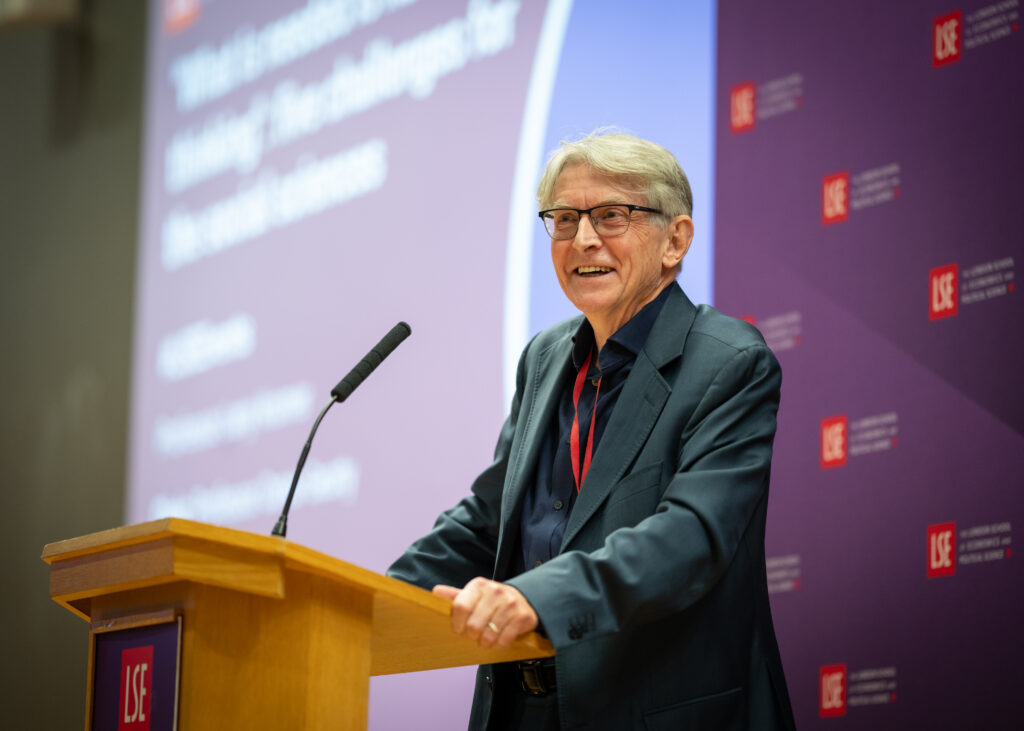
In the decades following the 9/11 attacks, complex webs of anti-terrorism laws have come into play across the world, promising to protect ordinary citizens from bombings, hijackings and other forms of mass violence. But are we really any safer? Has freedom been secured by active deployment of state power, or fatally undermined?
In his recent book, the title of this lecture, Conor Gearty unpacks the history of global anti-terrorism law, explaining not only how these regulations came about, but also the untold damage that he claims they have wrought upon freedom and human rights. Ranging from the age of colonialism to the Cold War, through the perennial crises in the Middle East to the exponential growth of terrorism discourse compressed into the first two decades of the 21st century, the coercion these laws embody is here to stay. The ‘War on Terror’ was something that colonial and neo-colonial liberal democracies had always been doing―and something that is not going away. Anti-terrorism law no longer requires terrorism to survive. And with Israel’s recent destruction of Gaza it is clear that for it and its Global North supporters, anti-terrorism no longer needs law of any sort to claim legitimacy.
Book Talk: “Fabricating Homeland Security: police entanglements across India and Palestine/Israel”
Academic talk presented by Dr Rhys Machold.
Wednesday, 5 February, 11:30-13:00
Arts Seminar Room 8
Co-sponsored by the Centre for Global Law and Governance (CGLG) and the Centre for Peace and Conflict Studies (CPCS), this event hosted Dr Rhys Machold, Senior Lecturer at Glasgow University, who discussed his recently published book Fabricating Homeland Security: police entanglements across India and Palestine/Israel (Standford University Press).
Rhys’ book shows that homeland security is rarely just a matter of the homeland: it involves the circulation and multiplication of policing practices across borders. Pairing insights from science and technology studies with those from decolonial and postcolonial theory, Fabricating Homeland Security looks at the fall-out of the 2008 Mumbai terrorist attacks, concentrating on the efforts of Israel’s homeland security industry to advise and equip Indian city and state governments.