
As in the case of almost any election, the 2026 May 7th Scottish Parliamentary Election arrives at a moment of considerable political intrigue. Boundary reforms, rising electoral fragmentation, new manifestations of populism, demographic realignment, and unusually high levels of incumbent retirement have combined to create one of the most unique contests for control of the Holyrood parliament since devolution came to pass almost three decades ago. Across Scotland, established assumptions about voting behaviour are being tested by shifting coalitions as a result of voter volatility and, saliently, the emergence of Reform UK as a significant electoral force.
In order to meet this timely moment with the salience it deserves, Katelyn Nutley, Kieran O’Meara and Dr. Nick Brooke called to convene the University of St Andrews Elections Monitoring Project (STAEMP) with a focus on Scottish Parliamentary Elections from within the university’s School of International Relations (IR), with support from the Centre for Global Law and Governance (CGLG). STAEMP is a collaborative research collective, comprised of research assistants (RAs) that are at various stages in their undergraduate studies. Together, alongside Ms. Nutley, Mr. O’Meara and Dr. Brooke, these 14 RAs have worked as co-learners in order to monitor, collate and forecast polling for the May elections with a public-facing character.
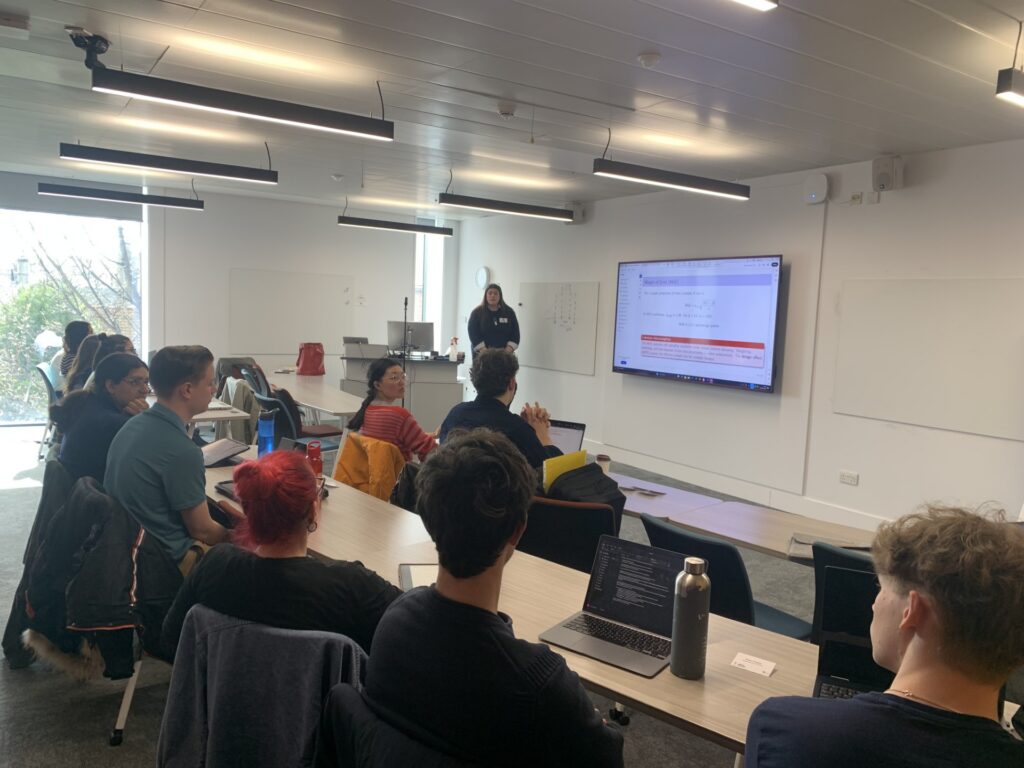
Part of this has been a series of public events held at the University. The first was on the 13th of April, wherein the CGLG sponsored a two-hour hybrid Roundtable event to discuss the upcoming election. This featured Ms. Nutley and Mr. O’Meara as Chairs, alongside panellists Dr Jan Eichhorn (University of Edinburgh), Allan Faulds (Editor-in-Chief, Ballot Box Scotland), Mark McGeoghegan (University of Glasgow and IPSOS UK), and the renowned Professor Sir John Curtice (University of Strathclyde). At this event, members of the public, students and associated RAs were given the opportunity to engage with the panel of leading experts. Equally, on election day, STAEMP will meet from 1-3pm in School V at another event open to the public in order to share their findings.
Central to this public-facing stance has been the Holyrood 2026 Scottish Parliament Election Tracker, designed, architecturally coded and computationally maintained wholly by Katelyn Nutley. This dashboard visualises Scottish election and public opinion data, making it easier to track, monitor and forecast Scottish parliamentary voting intention at any one time. It brings together voter intention for both regional and constituency-level polling data by three major firms (Survation, Norstat and IPSOS UK), alongside a highly novel constituency-level incumbency tracker, in order to produce interactive charts and projections about potential seat share and partisan performance. Naturally, this has been designed with Open Access in mind, relaying back to the democratic, collective and public-facing values of the project itself. That brings us to this piece.
The purpose of this piece is to analyse the political, demographic, and electoral dynamics shaping the 2026 Scottish Parliamentary Election through the study of incumbency, boundary changes, polling trends, voter behaviour, and party competition; all phenomena that can be explored using the data collated by STAEMP to computationally forge the above dashboard. It is our contention that by doing so we may better understand changing voter behaviour, party support, and demographic trends in the build-up to the 2026 Scottish Parliamentary Election alongside its implications for government formation and the future of Scottish politics.
The analysis presented here suggests an electorate characterised by both continuity and change. While the SNP remains projected to emerge as the largest party, the certainty of this has weakened relative to previous elections. Indeed, within a number of polls, the SNP is likely to fall short of a majority. Labour’s recovery following the 2024 UK General Election appears to have stalled, the Conservatives continue to face pressure from Reform UK, and the Greens and Liberal Democrats (Lib Dems) retain pockets of stable support. Age has emerged as one of the clearest dividing lines in Scottish politics, particularly regarding constitutional preferences and support for newer or populist parties.
Importantly, these developments carry implications beyond party competition alone. They raise wider questions about the kind of society Scotland wishes to be. In a parliament where small changes in vote share can produce substantial consequences under the Additional Member System (AMS), the interaction between constituency victories, regional allocation, and demographic turnout may prove to be decisive.
This piece is structured so that each section has been written by the pair of undergraduate RAs responsible for collating that specific dataset for the dashboard. The section exploring incumbency comes first and is followed by separate Survation, IPSOS UK, and Norstat sections, each divided into constituency and regional-level analysis. Within each section, the RAs interpret their assigned firm’s polling data and examine this across key demographic variables such as age, gender, region, education, and previous vote. This structure allows for a consistent, parallel comparison of findings across different datasets and levels of electoral analysis. Finally, the pedagogical impetus of STAEMP will be briefly laid bare, alongside some concluding thoughts.
Katelyn Nutley, Kieran O’Meara and Nick Brooke
Incumbency by Joel Bradford and Clare Sacks
Ahead of the 2026 Scottish Parliamentary Election, our role was to identify which MSPs are running again and which are stepping down. Overall, a record 32.6% of incumbent MSPs decided to step-down, including 38.4% and 25% of the constituency and regional MSPs, respectively. Our task was complicated by the Second Review of Scottish Parliament Boundaries, which, coming into force at this election, amended the boundaries to 43 constituencies and 6 of the 8 electoral regions. Applying the new boundaries to the results of the 2021 elections gives the ‘notional’ results, which differ slightly from the actual results. The other slight complication was the unusually high number of changes in party allegiance that took place during the course of the last parliament, including by-elections, defections and removals of the whip.
Concerning the regions, we identified the notional 2021 winners of seats in comparison to the 2021 results by applying the D’Hondt formula and the parties’ 2021 list candidates to the notional results. While the results remained the same in four of the regions, they differed in Glasgow, Edinburgh and Lothians East, Central Scotland and Lothians West and South Scotland. The most significant change was the two extra MSPs for the Greens, one at the expense of Labour in Glasgow (Kim Long) and the other from the SNP in South Scotland (Laura Moodie). In a parliament where every seat counts, these differences demonstrate the impact of boundary changes on parliamentary arithmetic and therefore government formation.
Many constituency boundaries were completely redrawn due to population changes. This is significant as it meant that not all constituencies had clear equivalents prior to the boundary changes, creating ‘open seats.’ Edinburgh Northern, for instance, is a good illustration of this, which holds no clear incumbent. However, the boundary changes at constituency-level were less impactful overall, not overturning any notional results. Despite this, they have nonetheless substantially altered the political landscape, for instance by making previously safe seats much more marginal, which has impacted which seats the parties have chosen to target; a great example of this is Edinburgh Southern. We will watch such seats with great interest, and we will also look out for any evidence of incumbency bias in the overall results.
Survation – Constituency by Leo Rodney and Gina Virdee
This next section seeks to examine Scottish constituency-level polling data gathered by Survation prior to the election on May 7th 2026. Its clients comprised Ballot Box Scotland, Diffley Partnership, Truth North Advisors and Quantum Communications. The primary method of data collection involved panels and interviews, both of which were carried out online.
At first glance, certain parties — the ‘populist’ parties — seem to draw support disproportionately from distinct genders. The Green Party, for example, consistently polls around twice as strongly among women, while Reform performs markedly better among men, who account for as much as 64.3% of its support. Beyond these cases, however, gender is a poor predictor of support for other parties.
The determinative correlation of voter preference with age is varied. The SNP attracts around 30% of voters from each age-grouping, suggesting support irrespective of age. Nevertheless, the association between older voters and a constitutionally pro-Union stance is reflected in the SNP’s slightly weaker performance among the over-65s. Equally, popularity within the Green vote often slips from its peak of roughly 20% amongst the 16-24s to less than 1% among the eldest. By contrast, 51% of Conservative support stems from the over-65s, rendering age somewhat decisive in this case. Much like gender, support across age groups is more evenly spread for Labour and the Liberal Democrats, but often highest among the over-65s, reaffirming that the very oldest voters are the most inclined to vote for the long-standing established unionist parties.
Previous voting history is especially noteworthy. Survation’s latest poll indicates Reform voters are more loyal than SNP voters, with 96.87% of those intending to vote Reform on May 7th having done so in the 2024 UK General Election – compared with 87.96% for the SNP. Alongside that, it is significant that Reform is not merely a ‘threat’ to the Conservatives, having taken 20.53% of their 2024 voters, but has succeeded in winning 21.01% of 2024 Labour voters.
All in all, the SNP are forecast to secure the largest plurality of constituency votes, whilst Reform and Labour compete for second place. Crucially, Survation’s polling has not shifted dramatically over time, indicating and perhaps mirroring a temporal stability across the electorate. By Monday 11th May, we will know if this was the case.
Survation – Regional by Oliver Dann and Irene Jimenez Fernandez De Moya
Survation’s most recent regional list poll sees Reform (19.2%) pull ahead of Labour (16.9%), continuing a back-and-forth for second place behind the SNP (29.2%). Behind them, the Greens (11.7%) and Conservatives (11.6%) are vying for fourth, with the Liberal Democrats (9.2%) bringing up the rear.
One factor stands out: age, which Survation divides into six brackets. The Greens’ vote share rises sharply amongst 16-24-year-olds, polling 13 points above their overall list vote, while Reform’s share in the same group drops by 10 points. The pattern reverses amongst older voters: Reform’s largest gains come amongst voters aged 55-64 (+10 points), while the Greens slip 7 points amongst voters aged 65+.
These figures extend a trend to Scotland that Professor Sir John Curtice (2023) observed before the 2024 UK General Election, and indeed discussed at our Project’s April Roundtable in St Andrews: age is now the largest demographic division in UK-wide politics. They also bear directly on the question of Scottish independence.
SNP leader John Swinney has said he will push for a new referendum if the SNP wins an absolute majority on May 7th, needing at least 65 of 129 seats. Our estimates project them falling just short at 62 seats, losing only one 2021 regional list seat, despite an 11-point drop in their regional vote share since then. The D’Hondt formula, which favours smaller parties when allocating list seats, has cushioned the SNP’s slide.
If the SNP falls short of an absolute majority, Swinney will reportedly still call a referendum with the Greens’ support, who are projected to retain all eight of their 2021 list seats, yielding a combined pro-independence majority. (Kerr, 2026)Both parties poll higher amongst 16-24 and 25-34 voters than the four major unionist parties. However, public opinion on independence is volatile: YouGov’s (2026) two most recent polls show 50/50 and 44/56 Yes/No splits in February and March. Truly, 16-24 voters are both the most likely to vote ‘Yes’ (59% in March 2025), and the most likely to be undecided (26% in November 2025). No matter what, Swinney will need young SNP and Green voters to turn out in force to solidify his mandate for a referendum.
IPSOS UK – Constituency by Catherine Taylor and Zi Zi Wardle
IPSOS constituency polls are exclusively done for STV News. The 2026 polls (February and March) reveal interesting demographic patterns across age, gender, education, region, and past votes.
Across both polls, all age groups are most likely to vote SNP. Voting patterns are balanced amongst female and male voters, with exceptions for the Lib Dems (with mostly female intentionality) and Reform (mostly male). As far as level of education is concerned, each party returns a majority of non-graduate support – all apart from the Greens, which attracts intended support from university graduates. On average, parties retain previous voters: Conservative (40%); Labour (61%); Lib Dem (77.5%); SNP (77%). Statistics for previous Reform or Green voters are unavailable. However, notably, former Conservatives constitute a significant portion of those intending to vote Reform (35%).
Regarding individual party development (February-March), the Conservatives and SNP have gained support. Conservative growth stems from increased support from (a) younger voters (16-34) in both the Highlands and Edinburgh regions, alongside (b) previous Labour voters. Equally, SNP gains stem from (a) increased female voter support, (b) both younger (16-34) and older (55+) voters, (c) previous Conservative voters, and (d) these demographics concentrated in the Central, Mid Scotland and Fife, North-East, West, and Glasgow regions.
By contrast, Labour and Reform lost support in early 2026 (February-March). Support for Labour from voters aged 16-34 and the Mid Scotland and Fife and West regions has halved. There has also been decreased support from previous Labour (68% to 54%) and Lib Dem (19% to 5%) voters. Most notably, support in West Scotland has almost halved for Labour (36% to 17%). In the same time period, Reform has experienced a noticeable decrease in support from (a) male voters, (b) previous Conservative voters, and (c) voters in the Highlands and South regions. Significantly, support in the North-East region has fallen sharply (30% to 16%) since February.
Interestingly, support for the Lib Dems and Greens has remained stable but still exhibits some volatility. The Lib Dems have experienced increased support in the Highlands, receiving an increase in intended support from those returning to the Lib Dems after briefly voting for others, especially in Shetland and Orkney. Conversely, the Greens have seen a notable decrease in support in the Glasgow and Edinburgh regions, yet gained appreciation amongst those aged 35-54 and former SNP voters. Together, these trends reveal mixed patterns of gains and losses between February and March.
IPSOS UK – Regional by Bella Broadhurst and Julia Parrish
As Vampa, Convery and McMillan (2026) contend, Populist radical right parties (PRRPs) have historically failed to gain traction in the Scottish political system, especially relative to other European nations. This exceptionalism appeared durable until the 2024 UK general election, after which Reform UK’s regional list support rose from approximately 2% in January 2024 to 16% in June 2025. Since June 2025, Reform’s regional list vote share has remained broadly stable at approximately 16%. Analysis of the demographic composition Reform’s Scottish support base offers insight into the nature of this growth.
Consistent with the literature on gendered voting patterns (Spierings and Zaslove, 2017), male respondents report higher levels of support for PRRPs than female respondents in polling. However, the size of this gender gap in this case has fluctuated across periods. In June 2025, there was a 13-point gap of support between male and female respondents for Reform (22% vs 9%, respectively) narrowing to just 8-points in February 2026 (18% vs 10%), and even further to 4-points by the March (19% vs 14%). Thus, recent polling data reflects the possibility that support for Reform may be increasing with women, despite its original male skew.
Analysis of past voter data permits consideration upon which parties have suffered the most from Reform’s rise. IPSOS Regional Polling data from June 2025 shows that 37% of those intending to vote for Reform had previously voted for the Conservatives, with Labour, Liberal Democrats, and the SNP losing 14%, 13% and 11% of intended supporters respectively.
By the time March 2026 arrives, IPSOS polling data comes to reveal that all parties had similarly lost previous voters to expected Reform intentionality: 35% of past Conservative voters, 10% of Labour voters, 12% of Liberal Democrat voters and 23% of SNP voters. Notably, the SNP is similarly suffering losses alongside other main Scottish parties on the regional level, suggesting that the constitutional question and almost two-decades in government is not enough to immunise the SNP from this trend.
Overall, these patterns are consistent with a gradual broadening of Reform’s Scottish electoral coalition, though further conclusions would require larger subgroup samples, additional polling waves, and post-election results data.
Norstat – Constituency by Arden Griffin and Sasha Kamenskii
The constituency-level data on Scottish Parliamentary voting intention, conducted by Norstat on behalf of The Sunday Times, spans 27 polls from March 2021 to April 2026. The data suggests a Scottish party system undergoing fragmentation among constitutionally unionist parties, while the SNP retains a diminished but still significant lead in vote share.
The SNP has experienced a steady decline since peaking at 45% in April 2021, losing roughly 13 percentage-points over five years. Its support stabilised at around 30–32% by late 2024 and has remained at that level into 2026. Although this represents a substantial decline in intended vote share, the electoral consequences are in fact increasingly limited as Scotland’s AMS electoral system rewards constituency pluralities. As a result, the SNP’s continued first-place position can be said to matter more than the scale of its decline. With opposition support divided among four major parties, Norstat polling still projects the SNP as the leading party with roughly 32% of the intended vote share.
Labour’s intended share is by far the most volatile in the dataset. The party rose from 17% in mid-2021 to 30% by May 2024, benefiting from the wider UK-wide surge under Keir Starmer, before falling back to 15–17% by early 2026 as incumbency at Westminster appeared to weaken its Scottish support base.
The Scottish Conservatives have experienced the sharpest decline in Norstat polling, falling from 22% in June 2021 to around 9–10% in 2026. This decline appears closely linked to the rise of Reform UK. Reform first appeared in Norstat polling in August 2024 at 8%, climbed to 19% by September 2025, and currently polls between 13% and 17% in 2026 surveys. The party appears to draw disproportionately from former Conservative voters. In 2026 Norstat polling, between 32% and 40% of Reform UK constituency-level supporters reported having voted Conservative in the 2021 Holyrood constituency election. This marks a substantial increase from the 13–23% recorded between August and December 2024 and reaffirm the claim that Reform are gaining traction in Scotland.
The Scottish Liberal Democrats have remained comparatively stable throughout the period, polling between 6% and 10%. Meanwhile, the Scottish Green Party recorded a modest increase in support, rising from 2–6% between 2021 and 2024 to 6–8% between 2025 and 2026.
Overall, the data points towards an SNP plurality government facing a fragmented opposition, with Reform UK and Labour competing for second place, while the Conservatives risk being reduced to their smallest-ever contingent at Holyrood.
Norstat – Regional by Kirsten Callan and Zac Copley
The data we were tasked with locating was to be collected from Norstat regional polls of intended Scottish parliamentary vote. We pooled data from various demographics and chose to focus on the intersection of social class (SEG) and gender. A note on definitions; ABC1 delineates ‘middle class’ individuals, including higher managerial, intermediate managerial and supervisory/clerical roles. C2DE delineates ‘working class’ occupations including skilled manual, semi-skilled alongside unskilled occupations, and the unemployed. These categorisations do not represent income and individual class variation within each group.
A notable limitation of the Norstat dataset is that it reports regional vote intention using national-level regional figures rather than estimates for each individual electoral region. This is significant because AMS combines First Past the Post constituency-level outcomes with a proportional regional allocation under the D’Hondt method, meaning constituency outcomes directly influence the distribution of regional seats. As a result, nationwide regional trends can differ substantially from region-specific voting patterns. For a comparative example, the March 2026 Ipsos poll found the SNP polling at 18% among ABC1 voters and 19% among C2DE voters in Edinburgh and Lothian East, compared with the Norstat regional figures of 26% and 37% respectively over a similar period.
Regional Norstat SEG trends in voting intention reveal the SNP vote declining between 2020 and 2023, prior to stabilising thereafter at roughly 25% among ABC1 voters and 35% among C2DE voters. Labour, by contrast, has experienced much sharper fluctuations. Since 2024, its intentional support has fallen to around 15%, with patterns of ABC1 and C2DE support increasingly converging in the most recent polls.
Fresh polling also suggests a growing age divide in voting behaviour. Younger voters of both genders are significantly more likely to support Labour, while older voters of both genders are considerably more likely to back Reform UK. These patterns may point to a broader realignment between Labour and Reform, both of which have gained support in recent years. Reform currently polls at around 15% among ABC1 voters and 24% among C2DE voters, suggesting that some older working-class Labour voters may be shifting towards Reform.
Finally, support for the Scottish Green Party has recently diverged along class lines, with ABC1 voters now recording more than double the level of support seen among C2DE voters. However, the latest available poll dates from March, so these figures may not fully reflect current voting intentions. This is particularly relevant given the Greens’ recent decision to contest six constituency seats, a move that could reduce their regional vote share and potentially benefit the SNP in closely contested areas.
Some Pedagogical Thoughts by Katelyn Nutley, Kieran O’Meara and Nick Brooke
Alongside its substantive focus on Scottish electoral politics, STAEMP was conceived as a pedagogical adventure in collaborative learning. The project sought not simply to teach students about elections, polling, and psephology in an abstract sense, but to immerse undergraduate researchers directly within the processes of data collection, interpretation, forecasting, and public engagement that shape contemporary electoral analysis. In this respect, the project was grounded in a broader understanding of political education as both intellectually rigorous and democratically significant.
Building upon the work of Dana Villa (2019) in exploring the history of political education in modern European political thought, William Sokoloff (2020: 4) defends the crucial claim that: ‘Political scientists are committed to democracy and to educating the public. After all, democracy and education are reciprocally reinforcing practices. The quality of the former depends on the quantity of the latter.’ This reciprocal relationship between democratic life and political education informed STAEMP from the outset. In this, the project attempted to open a site of multiple opportunities for students to not only study democratic politics by exposure to quantitative methods, but also to participate meaningfully in public-facing democratic analysis through engagement with live electoral data and contemporary political developments.
In order to achieve these aims, the role of the undergraduate researcher was deliberately structured so as to cultivate curiosity within the research collective. In this open and collaborative space, curiosity functioned not merely as an individual intellectual disposition, but as a constitutive social condition of collective inquiry – in our case in that of pairs. This enabled collaboration to emerge through shared processes of interpretation and analysis. In turn, this fostered a radically democratic learning environment wherein knowledge was not simply being exchanged, consumed, extracted, alienated from or reproduced, but actively participated with in its production. As such, the project sought both to ‘impart’ knowledge – acknowledging that a relational hierarchy inevitably persists in some form within the space where institutionalised teaching occurs, especially of quantative psephological methods – whilst simultaneously attempting to ‘produce’ knowledge collaboratively through a more radically democratic pedagogical ethic grounded in co-learning, participation, and shared intellectual responsibility.
Equally important therefore became the question of how students experienced this process as one phenomenally connected to the democratic communality of the project itself. If, as Rosen (2024: 114-115) argues: ‘Our task is to harness our expertise in service of student learning, by designing student learning experiences,’ we recognised that the experience of STAEMP was as constitutively significant for its democratic ethics to manifest as the site from which this experience could emerge.
Building further on this, Rosen (2024: 63) suggests that the role of the political scientist that teaches is not merely to transmit content, but to consider how students encounter knowledge production as an active process. STAEMP therefore emphasised co-learning and collaborative inquiry, encouraging student researchers to move beyond passive consumption of knowledge towards direct participation in its production and communication. In practice, this meant students taking ownership over datasets, learning to interpret polling fluctuations, debating methodological limitations, and collectively producing public-facing analysis under conditions that mirrored real research environments.
This orientation aligns closely with traditions of ‘active learning’ within political science pedagogy. Leston-Bandeira (2012: 54) explains, ‘active learning is learning by doing; it is not simply about just doing an activity though it requires a process of thought in the way the activity is conducted and applied by the learner.’ The work undertaken through STAEMP reflected precisely this emphasis on embodied practicality and reflective application. Rather than treating polling data as static information to be simply input, coded or disaggregated, students were asked to interrogate trends, contextualise demographic shifts, and critically assess the implications of electoral volatility within Scotland’s AMS system on their own terms – the results of which are presented above in this very piece.
Indeed, as Gunn (2017: 310) argues, psephology offers a particularly effective vehicle for quantitative political learning because it recreates the experience of ‘being a psephologist’ through engagement with ‘real world’ political data. In this manner, knowledge itself was neither static nor foreclosed, but rather in a process of ‘becoming’ twinned with an experience of ‘being.’ This was especially important to the ethos of the project. The intention was not simply to simulate political analysis, but to situate students within genuine public debate that unfolds alongside the consciousness of the researcher in the process of becoming alongside the object of research. In this manner, the living ‘real world’ character of psephology is a gift. Through roundtables, dashboard construction, collaborative writing, and public dissemination, students were able to experience the demands and responsibilities associated with producing accessible political knowledge for wider audiences; knowledge of democracy forged through it.
At the same time, STAEMP also sought to cultivate an intellectual environment attentive not only to output and performance, but to reflection, collegiality, and mutual support. In this sense, the project drew inspiration from Timperley and Schick’s (2026: 414) conception of ‘spacious learning’, alongside the aspiration identified by our colleagues Roxani Krystalli, Shambhawi Tripathi and Katharina Hunfeld (2023: 263) for ‘a gentler, more generative community of thought.’ At its best, STAEMP attempts to embody precisely this spirit: it is rigorous in analysis, collaborative in practice, democratic in ethos, and public-facing in purpose.
Conclusions by STAEMP
Taken together, the analysis presented throughout this piece suggests that the 2026 Scottish Parliamentary Election represents not merely another electoral cycle, but a moment of significant political transition within Scottish democracy. Electoral fragmentation, demographic realignment, constitutional uncertainty, and the rise of Reform UK collectively point towards a political landscape increasingly defined by volatility rather than stability, even as the SNP remains the dominant parliamentary force. Equally, STAEMP demonstrates the pedagogical and democratic value of collaborative research grounded in active student participation and open, public engagement with contemporary political life. Ultimately, both the election and this project underscore the continued importance of critically examining how democratic knowledge of democracy itself is produced, taught, communicated, and experienced in Scotland today.


Acknowledgements
STAEMP would like to acknowledge the School of International Relations at the University of St. Andrews for its support, both financial and logistic. A special thanks must go to Joyce Walsh, David Garland, Stella Gooding, Gillian Fleming and Dr. Ryan Beasley, without whom this project could not have got off the ground. We would also like to express our gratitude to Dr. Muireann O’Dwyer, Dr. Anette Stimmer, Prof. Anthony Lang Jr. and Anne Firmenich for the support of The Centre for Global Law and Governance. A special mention must also go to our Roundtable event panellists: Jan Eichhorn, Allan Faulds, Mark McGeoghegan and Sir John Curtice; alongside Shona Cameron and Fife Council Electoral Team for providing STAEMP observational access to the count in Glenrothes.
Reference List
Carr, R., Palmer, S. and Hagel, P. (2015) ‘Active learning: The importance of developing a comprehensive measure’, Active Learning in Higher Education, 16(3), pp. 173–186. Available at: https://doi.org/10.1177/1469787415589529.
Curtice, J. (2023) ‘Age, not class, is now the biggest divide in British politics, new research confirms’, The Conversation. Available at: https://doi.org/10.64628/AB.qxct9hcn7.
Gunn, A. (2017) ‘Embedding quantitative methods by stealth in political science: Developing a pedagogy for psephology’, Teaching Public Administration, 35(3), pp. 301–320. Available at: https://doi.org/10.1177/0144739417708838.
Kerr, S. (2026) ‘SNP vows to push for new independence vote with or without a majority’, Financial Times, 27 April 2026. Available at: https://www.ft.com/content/6672f983-2147-4410-a972-0bb2bd94cf39?syn-25a6b1a6=1. (Accessed: 5 May 2026).
Krystalli, R., Tripathi, S. and Hunfeld, K. (2023) “Making friends with uncertainty: Hopeful futurities in telling stories about global politics”, in A. Shesterinina and M. Matejova (Eds.), Uncertainty in Global Politics. London: Routledge, pp. 252-269.
Leston-Bandeira, C. (2012) “Enhancing Politics Teaching through Active Learning”, in C. Gormley-Heenan and S. Lightfoot (Eds.), Teaching Politics and International Relations. London: Palgrave Macmillan UK, pp. 51–64. Available at: https://doi.org/10.1057/9781137003560_5.
Rosen, A.M. (2024) Teaching Political Science: A Practical Guide for Instructors. Cham: Springer International Publishing (Political Pedagogies). Available at: https://doi.org/10.1007/978-3-031-58290-5.
Sokoloff, W.W. (2020) Political Science Pedagogy: A Critical, Radical and Utopian Perspective. Cham: Springer International Publishing. Available at: https://doi.org/10.1007/978-3-030-23831-5.
Spierings, N. and Zaslove, A. (2017) ‘Gender, populist attitudes, and voting: explaining the gender gap in voting for populist radical right and populist radical left parties’, West European Politics, 40(4), pp. 821–847. Available at: https://doi.org/10.1080/01402382.2017.1287448.
Timperley, C. and Schick, K. (2026) ‘Spacious learning: A critical reflection on active learning in political science’, Politics, 46(2), pp. 412–420. Available at: https://doi.org/10.1177/0263395725 1370594.
Vampa, D., Convery, A. and McMillan, F. (2026) ‘Symbiotic Polarization as a Barrier to Populist Radical Right Success: Scottish Exceptionalism in Comparative Context’, Political Studies, pp.1-28 Available at: https://doi.org/10.1177/00323217251410750.
Villa, D. (2019) Teachers of the People: Political Education in Rousseau, Hegel, Tocqueville, and Mill. Chicago, IL: University of Chicago Press. Available at: https://press.uchicago.edu/ucp/books/book/ chicago/T/bo26261884.html (Accessed: 5 May 2026).
YouGov (2026) ‘Scotland political snapshot, Spring 2026,’ YouGov.com. Available at: https:// yougov.com/en-gb/articles/54494-scotland-political-snapshot-spring-2026 (Accessed: 6 May 2026).
STAEMP – Scottish Parliamentary Elections Monitoring Project
Undergraduate Reading List
Below is a non-exhaustive selection of academic materials to aid an understanding of recent elections in Scotland, its electoral system, voting behaviours, and outcomes.
Aiton, A. et al. (2021) Election 2021. SB 21-24. Edinburgh: The Scottish Parliament, pp. 1–27. Available at: https://digitalpublications.parliament.scot/ResearchBriefings/Report/2021/5/11 /591dc3c7-d994-4bbd-8120-767e9e781a67 (Accessed: 22 March 2026).
Bennie, L. (2023) ‘A Critical Time for the SNP: A New Leader and “First Activist”’, Political Insight, 14(2), pp. 4–8. Available at: https://doi.org/10.1177/20419058231181276a.
Curtice, J. (2020) ‘High noon for the Union?’, IPPR Progressive Review, 27(3), pp. 223–234. Available at: https://doi.org/10.1111/newe.12217.
Curtice, J. (2025) ‘The electoral system: All a question of geography’, Parliamentary Affairs, 78(Supplement_1), pp. 30–47. Available at: https://doi.org/10.1093/pa/gsaf023.
Denver, D. and Johns, R. (2022) ‘Elections and Electoral Systems’, in D. Denver and R. Johns (eds) Elections and Voters in Britain. Cham: Springer International Publishing, pp. 229–252. Available at: https://doi.org/10.1007/978-3-030-86492-7_8.
Hassan, G. (2025) ‘The UK General Election in Scotland: The End of an Era, Age of Ultra-Competition or Interregnum?’, The Political Quarterly, 96(1), pp. 102–110. Available at: https://doi.org/10.1111/1467-923X.13499.
Henderson, A. et al. (2022) ‘Electoral Behaviour 2015–2019: The Multilevel Scottish Voter’, in A. Henderson et al. (eds) The Referendum that Changed a Nation: Scottish Voting Behaviour 2014–2019. Cham: Springer International Publishing, pp. 117–141. Available at: https://doi.org/10.1007/978-3-031-16095-0_6.
Henderson, A. et al. (2025) ‘The Devolved Nations’, in R. Ford et al. (eds) The British General Election of 2024. Cham: Springer Nature Switzerland, pp. 193–228. Available at: https://doi.org/10.1007/978-3-031-95952-3_6.
Henderson, A. and Mitchell, J. (2025) ‘Shifting sands: Sources of voter volatility in the 2024 UK General Election in Scotland’, Parliamentary Affairs, 78(Supplement_1), pp. 128–147. Available at: https://doi.org/10.1093/pa/gsaf032.
Johns, R. (2021) ‘As You Were: The Scottish Parliament Election of 2021’, The Political Quarterly, 92(3), pp. 493–499. Available at: https://doi.org/10.1111/1467-923X.13047.
McMillan, F. and Henderson, A. (2021) ‘Scotland’s Future? The 2021 Holyrood Election’, Political Insight, 12(3), pp. 37–39. Available at: https://doi.org/10.1177/20419058211045147.
Sturge, G. (2021) Scottish Parliament Elections: 2021. CBP9230. London: House of Commons Library, pp. 1–55. Available at: https://commonslibrary.parliament.uk/research-briefings/cbp-9230/ (Accessed: 22 March 2026).
STAEMP Co-learners
Katelyn Nutley is a PhD Candidate (International Relations) at the University of St. Andrews and PON Fellow at Harvard University.
Kieran O’Meara is a PhD Candidate (International Relations) at the University of St. Andrews.
Dr. Nick Brooke is Associate Lecturer in Terrorism and Political Violence at the Handa Centre for the Study of Terrorism and Political Violence in the School of International Relations at the University of St. Andrews.
Joel Bradford is a first-year student pursuing a Master of Arts (Honours) in German and International Relations.
Bella Broadhurst is a first-year student from Edinburgh, pursuing a Master of Arts (Honours) in International Relations.
Kirsten Callan is a first-year mature student pursuing a Master of Arts (Honours) in Psychology and International Relations, and has a background in people management.
Zac Copley is a second-year student studying for a Master of Arts (Honours) in International Relations with an interest in policy and security.
Oliver Dann is a fourth-year student completing a Master of Arts (Honours) in International Relations and Modern History.
Irene Jimenez Fernandez De Moya is a third-year pursuing a Master of Arts (Honours) in Economics and International Relations.
Arden Griffin is a third-year student studying for a Master of Arts (Honours) in International Relations and Sustainable Development.
Sasha Kamenskii is a second-year student completing a Master of Arts (Honours) in International Relations and Art History.
Julia Parrish is a second-year student pursuing a Master of Arts (Honours) in Economics and International Relations.
Leo Rodney is a second-year student completing a Master of Arts (Honours) in International Relations, French and German.
Clare Sacks is a fourth-year student from New York studying for a Master of Arts (Honours) in International Relations. She has recently completed her dissertation, titled: ‘Retweeting Rigged Elections: Social Media Discourse and Partisan Beliefs about Electoral Integrity.’
Catherine Taylor is a third-year student pursuing a Master of Arts (Honours) in International Relations and Philosophy.
Gina Virdee is a first-year student studying for a Master of Arts (Honours) in International Relations and Russian.
Zi Zi Wardle is a fourth-year student pursuing a Master of Arts (Honours) in International Relations and Sustainable Development.